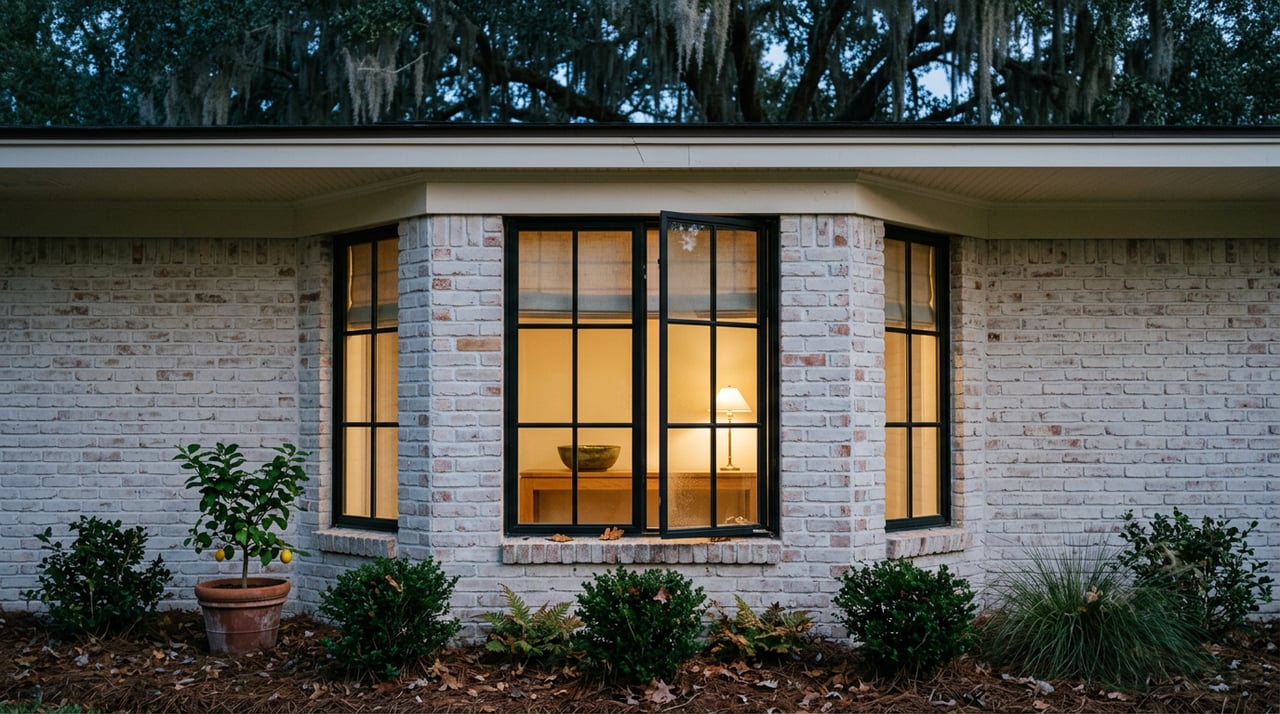
Two years ago, a Savannah seller inside the Downtown overlay could hand over a house with a mismatched replacement window, a repainted door, or an unpermitted rear addition, and the market absorbed it. Buyers waived inspections. Contracts closed in a week. Anything the seller had inherited from a prior owner traveled quietly with the deed.
That market is gone. The friction sellers now underestimate is not the Certificate of Appropriateness process itself. It is the older, quieter version of it: exterior work done by someone else, years ago, without a COA, surfacing during due diligence in a market that finally gives buyers time to look for it.
A Recent Denial Worth Reading Closely
On February 11, 2026, the Savannah Historic District Board of Review took up a petition at 318 East Huntingdon Street. The request was an after-the-fact approval for exterior alterations that had already been installed. The Board denied the after-the-fact request for exterior alterations at 318 East Huntingdon Street, on the grounds that the installed and updated materials did not comply with the Downtown Historic District Design Standards.
A denial like that does not erase the work. It leaves the property owner responsible for bringing the exterior back into compliance, on the Board's terms, on the Board's schedule. For a seller under contract, that timeline collides with a closing date. For a buyer's attorney, it becomes a title and disclosure conversation. For an appraiser, it becomes a condition note.
The Board meets on the second Wednesday of most months at 1:00 p.m. at 112 East State Street, and its 2026 calendar is fixed months in advance. A seller who discovers a compliance issue in July does not get to negotiate their way onto the July agenda. They wait.
Which Board Actually Reviews Your Block
Sellers often assume "historic district" is one designation with one process. It is not. Savannah has parallel review bodies with separate jurisdictions, and knowing which one governs your property is the first practical question in a listing conversation.
- Savannah Downtown Historic District — reviewed by the Historic District Board of Review (HDBR). The HDBR was created in 1973 to protect historic buildings, structures, appurtenances, and places of vital importance to the City of Savannah, and its primary focus is to review and issue Certificates of Appropriateness within the local Savannah Downtown Historic District.
- Victorian, Streetcar, and Cuyler-Brownville Historic Districts — reviewed by the Historic Preservation Commission (HPC). The HPC is the review authority for local historic districts and conservation districts including the Victorian Historic Overlay, Cuyler-Brownville, Streetcar, Ardsley Park-Chatham Crescent, Ardmore, Daffin Park and Parkside, and Carver Village, and it has no review authority over the Savannah Downtown Historic Overlay District.
- Ardsley Park-Chatham Crescent, Ardmore, Parkside, and Carver Village Conservation Districts — HPC reviews demolition of contributing buildings and other conservation-district items.
Certain material changes in the appearance to resources within the Savannah Downtown, Victorian, Streetcar, Cuyler-Brownville, Ardsley Park, Ardmore-Chatham Terrace, and Historic Carver Village districts may require an application to secure a Certificate of Appropriateness. Whether a specific past project needed one is often the exact question that has to be answered during a sale.
Staff Review vs. Board Review: The Split That Matters at Contract
Two different tracks handle two different scopes of work. This distinction is where most seller anxiety lives, because it decides whether a fix is a two-week problem or a two-month one.
| Track | Scope of work | Typical timeline |
|---|---|---|
| Staff Review | Color changes, roof repair or replacement, awnings, stucco repair, brick repointing, shutters, windows | Up to ten business days upon receipt of a completed application |
| Board Review | Rehabilitation, alterations, additions, new construction, signs, fences, demolition | Docketed on the next available meeting agenda |
Two rules on this table quietly determine how painful an after-the-fact issue becomes. First, all work that affects the exterior of buildings in a historic district must receive a Certificate of Appropriateness before a building permit can be obtained. Meaning: if a prior owner replaced the front windows without a COA, there is no clean permit trail to hand a buyer. Second, three or more staff review items automatically become a Board Review application, and application requests for non-contributing structures are automatic Board Reviews. A house with several small unapproved changes does not get to fix them quietly at the staff level. It moves up.
For the Downtown district, City Ordinance 3.19.4a requires the applicant to participate in a pre-application conference with MPC Staff before submitting an application for a COA that will require HDBR review, and pre-meetings must be held a minimum of one week prior to the submission deadline. A seller trying to compress this into a normal due-diligence window will lose.
Why 2026 Turns This Into a Seller Problem
The after-the-fact question existed in 2022. Buyers did not press it. In 2026 they do, because the market gave them room to.
As of May 2026, the Savannah metro's median sale price sat at $339,000, down 3.1% year over year, with homes taking about 82 days on the market compared with 57 days a year earlier. The Chatham County single-family average in March 2026 was 86 days on market, closer to a balanced pace than a seller's market. Local guides describe the Days on Market in Savannah stretching to 80 to 90 days after years of homes going under contract in 72 hours.
Two consequences flow from that number.
The first is scrutiny. When a buyer has ninety days of inventory to compare against your listing, they and their attorney read the disclosure form more carefully, run tax and permit history, and ask questions about visible exterior conditions that do not match a permit record. In the Downtown overlay, that reading is easier than most buyers realize, because Board actions are published in monthly action minutes tied to specific addresses.
The second is leverage. With homes sitting for three months rather than three days, sellers are increasingly motivated, and buyers can now demand that HVAC systems be serviced or roofs be repaired before finalizing the sale, ending the as-is era. A COA gap is not a repair request in the traditional sense. It is a title-clean-up request, and it tends to be resolved with a price concession, a holdback in escrow, or a seller commitment to complete the process post-closing under attorney oversight.
A slower market does not create the after-the-fact problem. It just gives buyers time to find it, and it hands them the leverage to price it in.
Georgia Disclosure Meets Local Overlay
Georgia is a caveat emptor state, which shapes how these conversations go. In practice, seller disclosure forms are based on the seller's actual knowledge and belief rather than a warranty that the home is free of defects, which means answers should be careful, honest, and based on what the seller truly knows. If you know about an unpermitted exterior change, you have a disclosure decision. If you do not know, the buyer's own inspection and permit search may raise it anyway.
For older Savannah housing stock, the federal layer sits on top. For homes built before 1978, federal law requires sellers to disclose known lead-based paint hazards before the contract is signed, and sellers must provide related records and give the buyer a 10-day opportunity to conduct a lead inspection or risk assessment. Most Downtown, Victorian, and Streetcar-district homes fall inside that window, which means a paint-related COA question and a lead-paint disclosure question can arrive in the same week.
What to Do Before the Sign Goes in the Yard
The single highest-leverage move is to resolve the paper trail before a buyer's attorney asks about it. A pre-listing plan for a historic-district property should include:
- Confirm overlay and jurisdiction. Pull the property's zoning designation and identify whether the HDBR or the HPC has authority. The MPC directs preservation questions to [email protected] or 912-651-1440.
- Walk the exterior with permit history in hand. Windows, doors, shutters, paint colors, roof material, HVAC screening, fences, and any rear additions are the usual suspects. Anything visible from the public right-of-way is in scope.
- Sort issues into Staff Review vs. Board Review. A single window swap is a different problem than three unapproved changes stacked on the same facade, which becomes an automatic Board matter.
- Book the pre-application meeting early. For the Downtown overlay, the one-week-prior pre-meeting requirement is a hard gate, not a courtesy.
- Decide the disclosure posture with an attorney. Georgia's actual-knowledge standard rewards honest, specific answers on the seller's property disclosure. Pair that with lead-based paint disclosure for pre-1978 homes.
- Set a listing price that reflects the corrective path. If the fix is a $6,000 window replacement and a two-month Board timeline, that is a real number in a real negotiation, and it belongs in the pricing conversation up front rather than in a repair addendum on day 60.
Questions Sellers Keep Asking
If a prior owner did the work, is it still my problem? For transaction purposes, yes. The obligation attaches to the property, not the person who performed the work. Buyers price the risk against the seller who owns it at closing.
Can I close and let the buyer handle the COA? You can negotiate that outcome, but most buyer attorneys will want either a price concession, an escrow holdback, or a signed acknowledgment of the specific non-compliance. Very few buyers accept the risk silently in a market with 80-plus days of inventory.
Does this only apply to the Downtown district? No. The Victorian, Streetcar, Cuyler-Brownville, and several conservation districts have their own review process under the HPC, with the same underlying principle that exterior changes require review before a permit is issued.
What if the change is decades old? Age does not cure a missing COA. The Board can still require the property be brought into compliance with current Design Standards, which is a large part of what makes after-the-fact petitions difficult.
Selling inside a Savannah historic overlay is still one of the most rewarding transactions in Coastal Georgia when it is prepared correctly. The homes are irreplaceable, the buyer pool is national, and the market rewards a listing that arrives clean. What has changed in 2026 is the cost of arriving less than clean. If you are considering a sale in the Downtown, Victorian, Streetcar, Cuyler-Brownville, Ardsley Park, Ardmore, Parkside, or Carver Village overlays, Toria Wallace would be glad to walk your property with you before the first photograph is taken. Let's Connect.